Disclaimer. This page summarizes publicly available Oregon statutes as of October 2026. Not legal advice. Verify and consult a licensed Oregon attorney.
- Legal status
- Legal
- Install permitted
- Statute
- ORS §815.225
- Chapter 815
- Audibility required
- 200 ft
- Factory horn minimum
- Specific dB cap
- None
- "Unreasonably loud" test
- Penalty class
- Class C
- Traffic violation
- Siren ban?
- Yes
- Emergency exempt
Are train horns legal in Oregon?
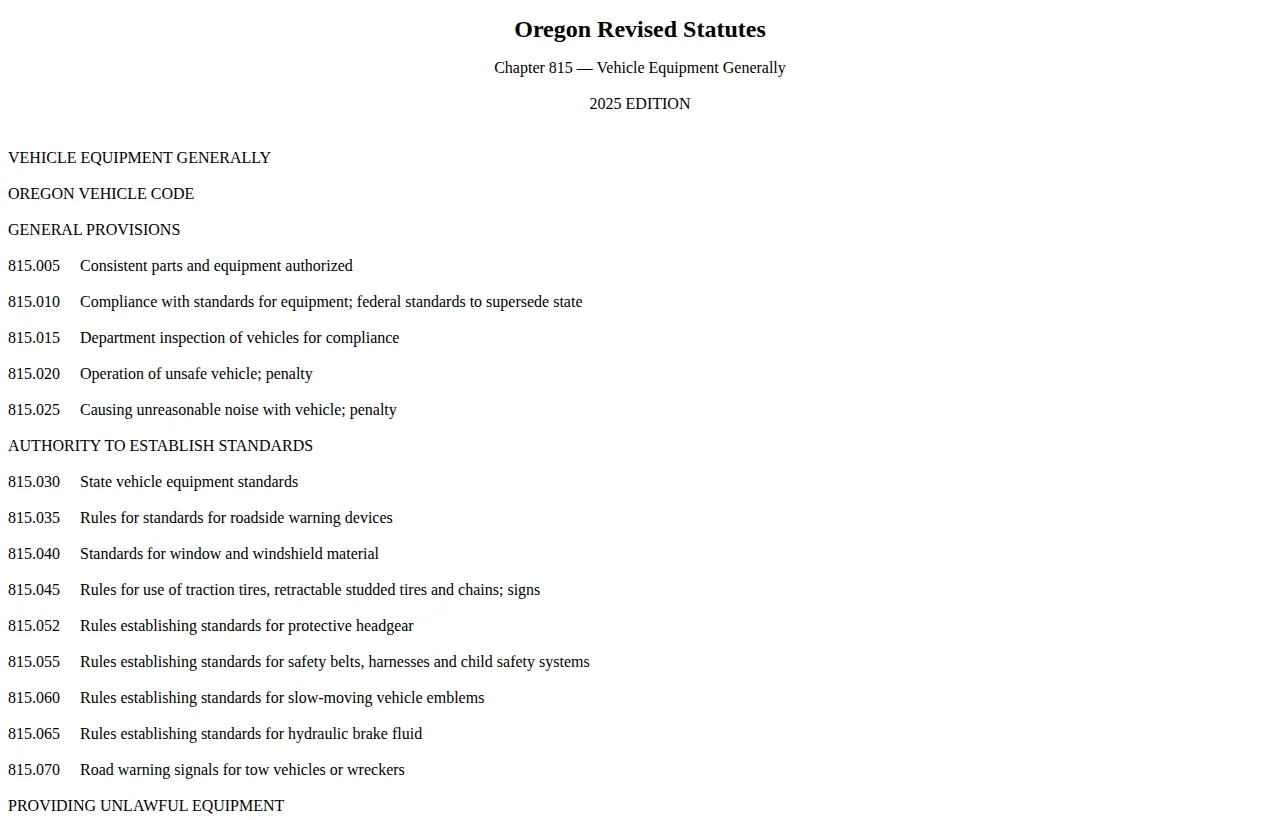
Installing an aftermarket train horn on a private vehicle in Oregon is not prohibited. Oregon train horn law sits in ORS §815.225 — “Violation of use limits on sound equipment.” Oregon requires every motor vehicle to have a horn audible at 200 feet (ORS §815.230); prohibits using a horn “otherwise than as a reasonable warning”; and prohibits “any unnecessary or unreasonably loud or harsh sound by means of a horn or other warning device.” Penalty: Class C traffic violation.
Install is legal; use on Oregon public roads — Portland, Eugene, Salem, Gresham, Hillsboro, Beaverton, Bend — is the regulated behavior.
What ORS §815.225 actually says
(1) A person commits the offense of violation of use limits on sound equipment if the person does any of the following: (a) Uses upon a vehicle, any bell, siren, compression or exhaust whistle. (b) Uses a horn otherwise than as a reasonable warning or makes any unnecessary or unreasonably loud or harsh sound by means of a horn or other warning device. … (3) The offense described in this section, violation of use limits on sound equipment, is a Class C traffic violation.
Operative rules: 200-ft audibility requirement (ORS §815.230); no use except “reasonable warning”; no “unnecessary or unreasonably loud or harsh sound.” Class C traffic violation penalty.
Updated 10/03/2026: the quote above now reproduces the statute verbatim from the 2025 edition of the Oregon Revised Statutes (the earlier version was a paraphrase). The substance is unchanged. A 2025 amendment (Oregon Laws 2025, chapter 278, section 12), operative January 1, 2027, adds organ transport vehicles to the emergency-vehicle exemption in subsection (2); it does not change the rules for private vehicles.
Does the factory horn need to stay working in Oregon?
Yes. ORS §815.230(1)(a): “A motor vehicle must be equipped with a horn in good working order, capable of emitting sounds audible under normal conditions from a distance of not less than 200 feet.” The same section, at (1)(b), provides that “No vehicle shall be equipped with any bell, siren, compression or exhaust whistle.” A multi-trumpet air horn is a horn, not one of those listed devices, but keep it a horn. Do not wire it to a siren module or add a whistle. Violating ORS §815.230 is also a Class C traffic violation.
Is a train horn a prohibited device under ORS §815.225?
- ·Use otherwise than as reasonable warning
- ·Unnecessary or unreasonably loud sound
- ·Harsh sound
- ·Class C violation penalty
- ·Multi-trumpet chord not enumerated in ban
- ·Install itself legal
- ·Use subject to ORS §815.225 tests
- ·Factory horn must remain functional
Portable and battery-powered train horns in Oregon
ORS §815.225 regulates “a horn or other warning device” — power source agnostic. M18, DeWalt 20V, Ryobi, Makita portables fall under the same rules.
Enforcement in practice
Oregon is moderately enforcing. Portland Metro (Multnomah, Washington, Clackamas counties) active; rural eastern Oregon rarely cites.
Practical Oregon train horn compliance
- 01 Keep factory horn wired and functional
Vehicle equipment requirement.
- 02 Put the train horn on a separate switch
Distinct from OEM button.
- 03 Don't use in Portland Metro traffic
Active enforcement + municipal noise codes.
- 04 Reserve use for off-road / events / private property
Oregon has substantial forest, desert, and coastal private-land use.
- 05 Watch Portland / Eugene ordinances
Municipal noise rules layer on state.
- 06 Hearing protection when testing
140+ dB causes immediate damage.
How to verify this page
Verify on Oregon Legislature ORS Chapter 815. Send a correction.
Nearby states & related laws
All 50 states →Washington
Washington train horn law (RCW 46.37.380): vehicle horn rules, Seattle / Tacoma / Spokane enforcement, aftermarket horn regulations. Plain-English guide.
California
California Vehicle Code §27000–27001 on aftermarket train horns: the 'unreasonably loud or harsh' rule, horn-use limits, and roadside enforcement. Updated June 2026.
Idaho
Idaho Code §49-956 covers vehicle horns. Install is not prohibited; use is limited to safe operation and sound must not be harsh. Plain summary.
Nevada
Nevada train horn law (NRS 484D.400): vehicle horn rules, Las Vegas / Reno enforcement, aftermarket horn regulations. Plain-English guide.
Continue on Train Horn
All 50 states
Full state-by-state legality index with statuses, citations, and decibel caps where defined.
Decibel distance calculator
Inverse-square-law tool that shows perceived loudness at any distance from the horn.
Battery-powered platforms
Horns organized by cordless-tool battery — Milwaukee M18, DeWalt 20V, Ryobi, Makita.
HornBlasters Shocker XL review
154 dB four-trumpet flagship kit — measured output, install notes, and verdict.
Sources & Citations
- [1] Oregon Legislature — ORS Chapter 815, §815.225 (use limits) and §815.230 (horn equipment), 2025 edition
- [2] Oregon DMV — Vehicle Equipment
Educational content. Not legal advice. Verify current statutes with your state DMV or a licensed attorney before installation.