Disclaimer. This page summarizes publicly available Colorado statutes as of July 2026 and is published for general informational purposes only. It is not legal advice, and nothing on this page creates an attorney–client relationship. Statutes change, enforcement varies by jurisdiction, and individual circumstances matter — always verify the current text and consult a licensed Colorado attorney before making installation or use decisions that may carry legal consequences.
- Legal status
- Legal
- Install permitted
- Statute
- §42-4-224
- CRS Title 42
- Audibility required
- 200 ft
- Factory horn minimum
- Specific dB cap
- None
- "Unreasonably loud" test
- Audible-device clause
- Restrictive
- "No vehicle shall be equipped..."
- Penalty
- Traffic infraction
- Civil fine
Short answer
Installing a train horn on a private vehicle in Colorado is not prohibited in practice. C.R.S. §42-4-224 requires every motor vehicle on a highway to carry a horn audible at 200 feet, bars any horn from emitting “an unreasonably loud or harsh sound,” and adds a notable clause: “No vehicle shall be equipped with nor shall any person use upon a vehicle any audible device except as otherwise permitted in this section.”
That closing sentence is broader than most state horn statutes. It has not been consistently read as banning install of train horns, but it is the language Colorado officers reach for when they want to cite both installation and use.
What the statute actually says
Every motor vehicle, when operated upon a highway, shall be equipped with a horn in good working order and capable of emitting sound audible under normal conditions from a distance of not less than two hundred feet, but no horn or other warning device shall emit an unreasonably loud or harsh sound, except as provided in section 42-4-213(1) in the case of authorized emergency vehicles or as provided in section 42-4-222. The driver of a motor vehicle, when reasonably necessary to ensure safe operation, shall give audible warning with the horn but shall not otherwise use such horn when upon a highway. No vehicle shall be equipped with nor shall any person use upon a vehicle any audible device except as otherwise permitted in this section.
Operative rules:
- Every motor vehicle on a highway must carry a horn audible at 200 feet.
- No horn may emit “an unreasonably loud or harsh sound” — authorized emergency vehicles excepted.
- Horn use is limited to cases “reasonably necessary to ensure safe operation.”
- Additional audible-device restriction: “No vehicle shall be equipped with nor shall any person use upon a vehicle any audible device except as otherwise permitted in this section.” This is the clause that distinguishes Colorado from purely UVC states.
No specific dB cap — the “unreasonably loud or harsh” test governs.
Does the original factory horn need to stay operational?
Yes. The 200-ft audibility rule applies to the vehicle’s equipment independent of any additional horns. Disconnecting the factory unit in favor of a train-horn-only setup puts the vehicle out of §42-4-224 compliance, regardless of the aftermarket horn’s loudness.
Run both in parallel: factory horn on the OEM button, train horn on a dedicated switch.
Is a train horn an “audible device” subject to the equip-prohibition clause?
This is the Colorado-specific question. §42-4-224 includes this clause:
“No vehicle shall be equipped with nor shall any person use upon a vehicle any audible device except as otherwise permitted in this section.”
Read literally, it could be interpreted as barring the installation of any audible device that isn’t affirmatively authorized. However, the statute’s primary subject is the horn itself, which is authorized — and the clause is generally read in context as a restriction on additional types (sirens, whistles, bells), not on a second horn that happens to be louder than the factory unit. Colorado courts have not issued a published decision narrowing this question.
Practical read: a compliant factory horn plus an aftermarket train horn (with the train horn used only as permitted for “safe operation” or on private property) is the conservative posture. A disconnected factory horn with a train horn as the only audio device risks both the 200-ft failure and the audible-device question.
- ·Officer-judged, no dB meter required
- ·Applies to all horns / warning devices
- ·Directly enforceable under §42-4-224
- ·Most common enforcement hook
- ·Colorado-specific language
- ·Could be read as installation-level bar
- ·Ambiguous as applied to train horns — no Colorado case law
- ·Conservative read: keep factory horn intact and use train horn sparingly
Portable / battery-powered train horns
§42-4-224 regulates any “audible device” on a vehicle without distinguishing power source. Portable train horns built on the Milwaukee M18, DeWalt 20V, Ryobi ONE+, and Makita LXT platforms fall under the same rules:
- Treated as “audible devices” on a vehicle.
- Subject to the “unreasonably loud or harsh” test if used on a highway.
- Cannot replace the factory horn for 200-ft audibility compliance.
Denver, Boulder, Colorado Springs, and other municipalities have their own noise ordinances that can apply on top of the state rule.
Enforcement in practice
Colorado is moderately enforcing for vehicle audio equipment. Front Range corridor cities (Denver, Boulder, Fort Collins, Colorado Springs) see more citations; mountain and rural counties rarely do. Common triggers:
- Use near residential areas, especially at night
- Complaint-driven stops
- Horn paired with other equipment violations (exhaust, lights)
- Use perceived as deliberately harassing
Install alone, without observed misuse, typically doesn’t trigger a stop.
Practical compliance
- 01 Keep the factory horn wired and functional
The 200-ft audibility requirement applies to the vehicle, not the train horn specifically. The OEM unit has to work.
- 02 Put the train horn on a separate switch
Clearly distinct from the OEM button. Covered or keyed switches add install discipline.
- 03 Don't use the train horn for ordinary traffic signaling
§42-4-224 limits horn use to cases 'reasonably necessary to ensure safe operation.' A novelty chord doesn't fit.
- 04 Reserve use for off-highway / events / private property
Colorado offers substantial off-highway land — trails, BLM, private property, closed events.
- 05 Check Denver / Boulder / Colorado Springs ordinances
Front Range cities layer their own noise rules on top of state law. Residential use near city limits can trigger municipal citations.
- 06 Hearing protection when testing
140+ dB causes immediate damage at close range. See our calculator to plan realistic distances.
Use our decibel distance calculator to see how loud your horn is at the distance of a bystander — the inverse-square law drops 6 dB per doubling of distance, so a 150 dB horn at 10 ft is about 130 dB at 100 ft.
How to verify this page
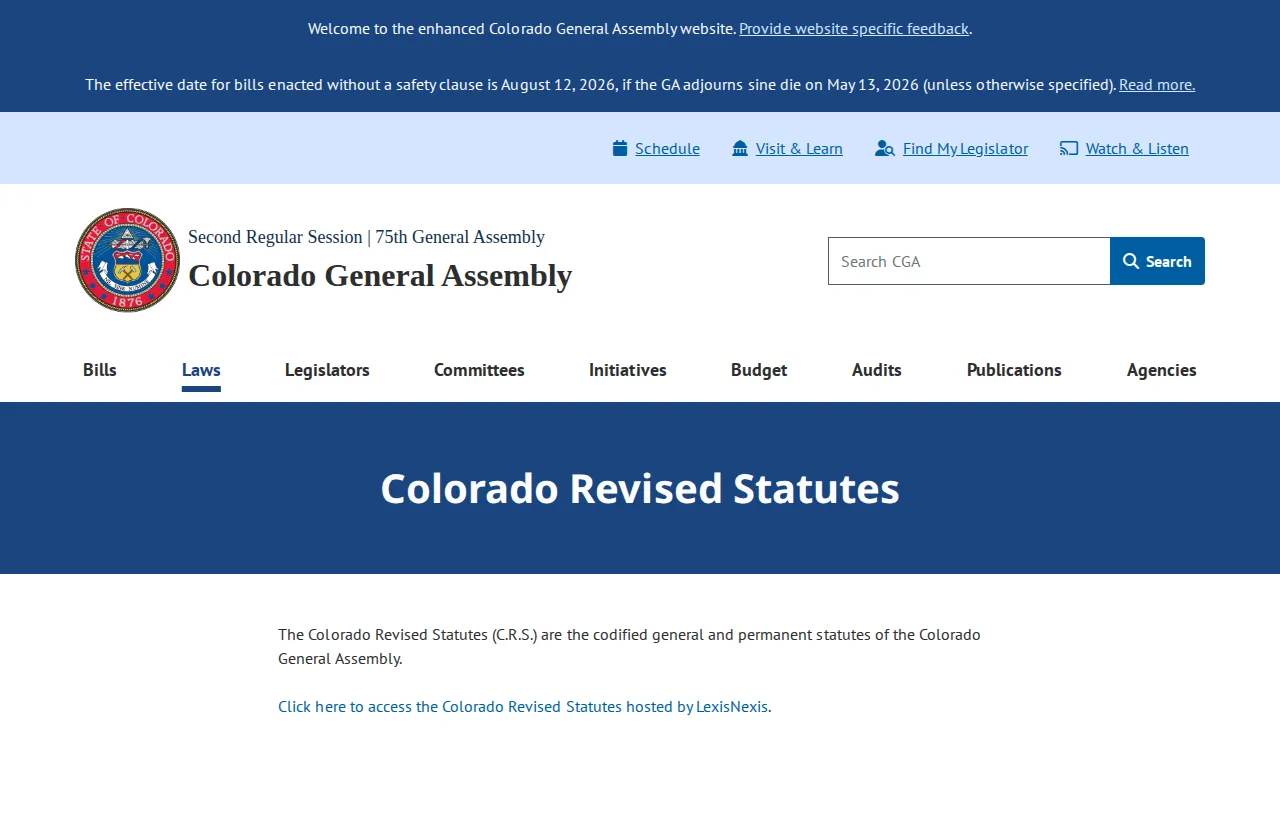
CRS sections can be amended. Before acting on anything here, verify the current version of §42-4-224 on the Colorado General Assembly’s official CRS portal and consult a licensed Colorado attorney for your specific situation. If you notice this page is out of date, please send a correction — we update within 48 hours when a cited source is provided.
Nearby states & related laws
All 50 states →Utah
Utah train horn law (Utah Code §41-6a-1625): vehicle horn rules, Salt Lake City / Provo enforcement, aftermarket horn regulations. Plain-English guide.
Wyoming
Wyoming train horn law (Wyo. Stat. §31-5-957): vehicle horn rules, Cheyenne / Casper enforcement, aftermarket horn regulations. Plain-English guide.
New Mexico
New Mexico train horn law (NMSA §66-3-843): vehicle horn rules, Albuquerque enforcement, aftermarket horn regulations. Plain-English guide.
Kansas
Kansas train horn law (K.S.A. 8-1738): vehicle horn rules, Wichita enforcement, aftermarket horn regulations. Plain-English guide with statute citations.
Continue on Train Horn
All 50 states
Full state-by-state legality index with statuses, citations, and decibel caps where defined.
Decibel distance calculator
Inverse-square-law tool that shows perceived loudness at any distance from the horn.
Battery-powered platforms
Horns organized by cordless-tool battery — Milwaukee M18, DeWalt 20V, Ryobi, Makita.
HornBlasters Shocker XL review
154 dB four-trumpet flagship kit — measured output, install notes, and verdict.
Sources & Citations
- [1] Colorado General Assembly — Colorado Revised Statutes (official portal)
- [2] Colorado DMV (DOR) — Motor Vehicle Laws
- [3] C.R.S. §42-4-224 — Horns or warning devices (Justia secondary)
- [4] C.R.S. §42-4-224 — Horns or warning devices (FindLaw, current through Jan 1, 2025)
Educational content. Not legal advice. Verify current statutes with your state DMV or a licensed attorney before installation.